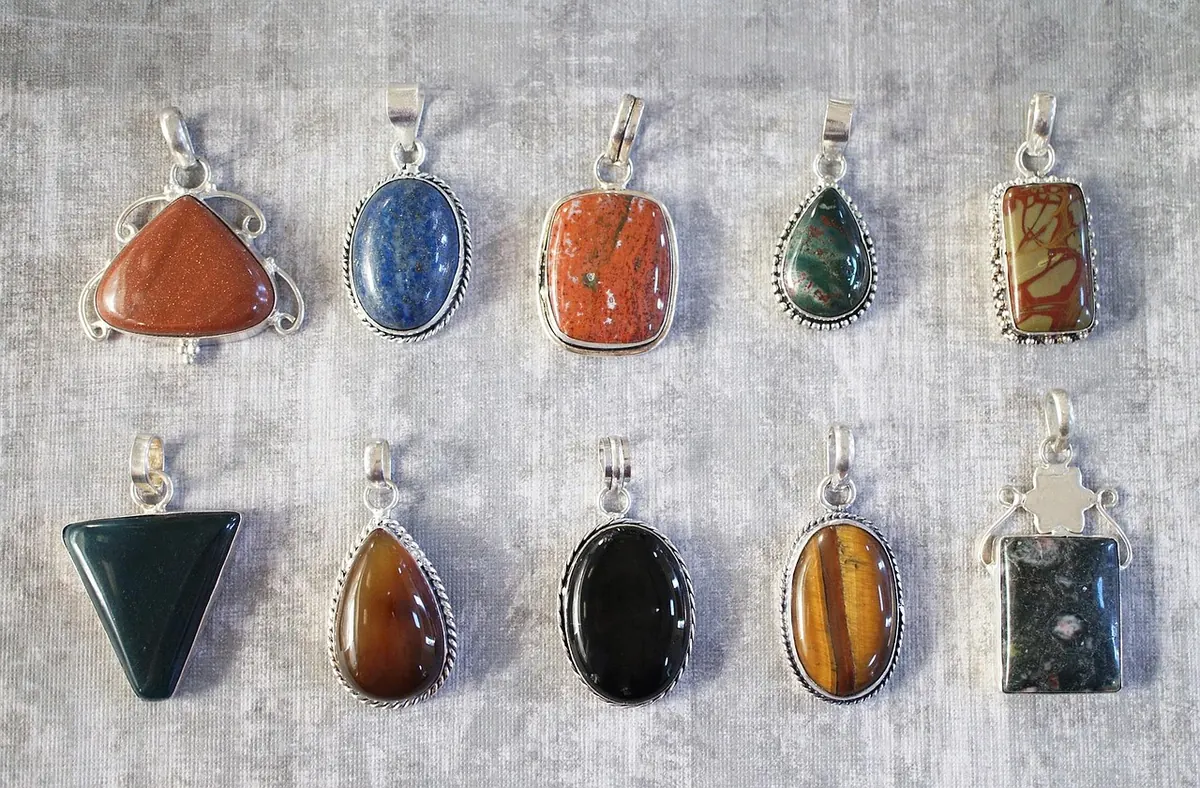
Black onyx has a quiet confidence about it. A flat black cabochon in a silver bezel, a strand of polished beads, a Deco-style ring with a sliver of black set flush into the band — it is one of the few gemstones that looks equally at home with a jumper and jeans or with evening wear. It is also one of the easiest stones to buy badly.
Much of what is sold as black onyx is dyed agate. Some of it is set in metal thin enough to bend the first time you catch it on a door handle. None of that is a reason to walk away. It is a reason to know what you are looking at before you hand over your card.
What you are actually buying
In the trade, "black onyx" almost always means chalcedony — a form of agate — that has been dyed black. Natural black onyx does exist, but it is uncommon, and most of what reaches a UK high street or online shop has been treated. This is not a swindle. Dyeing chalcedony black is a centuries-old practice, and it is the reason Victorian mourning jewellery looks the way it does.
What matters is disclosure. A seller who says plainly, "this is dyed agate, which is what black onyx usually is" is being straight with you. A seller who insists a twenty-pound ring contains an untreated natural gemstone is not.
Onyx sits around 6.5 to 7 on the Mohs scale, roughly the same as amethyst. That is perfectly good for a necklace, a bracelet or earrings. On a ring worn daily, the edges of the stone will eventually dull or chip, which is worth knowing before you spend a lot on a large faceted piece. Cabochons and flat tablets hide wear far better than faceted cuts.
Choosing the metal
Sterling silver
Silver, stamped 925, is the most affordable route and gives a crisp, graphic contrast against a black stone. It does tarnish, so look for pieces described as rhodium-plated or oxidised if you want to keep them looking sharp with minimal effort. Bear in mind that silver polish near a dyed stone is best avoided — clean the metal with a cloth and keep liquid polish away from the stone itself.
Gold
Yellow gold and black onyx is a classic pairing, particularly in 9ct (stamped 375) and 18ct (750). It reads warmer and more vintage than silver. White gold is usually rhodium-plated and looks similar to silver from a distance, but costs considerably more, so buy it because you want the gold, not the colour. Gold vermeil — a sterling silver base with a thick layer of gold plating — sits in the middle and wears far better than thin costume plating.
Steel, titanium and base metals
Stainless steel and titanium suit black onyx well, especially in men's rings and beaded bracelets, and they cope with water and everyday knocks. Brass and other base metals are fine at a low price point, but the plating will wear through eventually, often in patches around the edges.
In the UK, heavier pieces of precious metal should carry an assay office hallmark alongside the fineness stamp. Weight thresholds differ by metal, so if you are unsure whether a piece should be hallmarked, ask the retailer directly. A "silver" ring with no mark at all is a reason to walk away.
Settings, and why they matter more than you think
Because onyx chips at the edges rather than shattering, the setting is doing real protective work.
- Bezel: a rim of metal encircles the stone. Nothing protects a chip-prone gemstone better, and it suits the flat, graphic look of onyx. It does make the stone appear slightly smaller.
- Claw or prong: shows more of the stone and catches more light, but prongs snag on knitwear and, if one lifts, the stone can be lost. If you choose claws, look for four prongs set low rather than tall.
- Flush or gypsy: the stone sits down into the metal with nothing raised. Excellent for everyday rings and for anyone who works with their hands.
- Inlay and channel: slivers of onyx set level with the surface. Striking, but repairs are specialist work, so buy from someone who offers a repair service.
- Beads: check how the strand is put together. Knotted silk or a proper wire with a clasp will last; cheap elastic will not. Earrings should have secure backs, not loose butterfly fittings.
If a seller cannot tell you how the stone is set, assume it is set as cheaply as possible.
Getting the size right
UK ring sizes run in letters, with half sizes between them. Measure at the end of the day, when fingers are at their largest, and measure the knuckle as well as the base, because the ring has to pass over both. A band wider than about six millimetres usually needs a half size up; a very thin band can sit comfortably at your usual size.
For bracelets, measure your wrist snugly and add roughly one to one and a half centimetres. Beaded bracelets tend to roll, so err on the comfortable side. Necklaces are easier: around 40cm sits near the base of the throat, 45cm at the collarbone, and 50cm or more drops over a jumper.
One question worth asking before you buy: can it be resized? A plain silver or gold band usually can. A ring with inlay, channel-set stones or a full band of onyx often cannot, and that makes an accurate size far more important.
Ethical sourcing and honest answers
Most black onyx and dyed agate on the market is mined in Brazil, India, Madagascar or Uruguay and cut and dyed in India or China. Supply chains are long and often opaque, which is precisely why the questions you ask matter more than any badge.
- Where is the stone from, and has it been treated?
- Does the brand publish anything about its suppliers or its metal sourcing?
- Is the gold or silver recycled, or certified under a scheme such as Fairmined?
- Do they offer repairs, and is there a warranty?
There is no single certification that guarantees an ethically sourced gemstone. Fairmined and Fairtrade schemes apply mainly to gold, and membership bodies such as the Responsible Jewellery Council cover larger companies rather than a small online shop. The absence of a logo is not proof of poor practice, but a refusal to answer a straightforward question is a useful signal. Buying vintage or second-hand is a genuinely low-impact option, and old onyx pieces are plentiful.
Under UK consumer law, goods must be as described, so keep your receipt and make sure the description of the stone and metal is written on it. For anything valuable, consider a valuation for insurance, and speak to a qualified jeweller or valuer if you are spending a significant sum.
Looking after it
Take rings off for the gym, gardening and washing up. Clean onyx with lukewarm water, a drop of mild soap and a soft brush, then dry it with a cloth. Skip the ultrasonic cleaner, particularly on dyed stones — it can leach colour. Keep perfume, hairspray and chlorine away from it, and store pieces separately in a pouch, because a black stone scratched by a diamond is not cheap to put right. Note too that dye can fade over years, and re-polishing a dyed stone is a delicate job.
If a metal fitting ever irritates your skin, stop wearing it and take advice from a pharmacist or doctor rather than persisting.
A quick checklist before you buy
- Is the treatment disclosed honestly?
- Is the metal stamped 925, 375 or 750?
- Does the setting protect the edges of the stone?
- Are the measurements given in centimetres, with a size guide?
- Can it be resized or repaired?
- Is there a returns policy, and will you get a written description?
Get those six answers and you will end up with a piece you wear for years rather than one that sits in a drawer. Black onyx rewards a little patience at the buying stage — and it is forgiving enough to become the piece you reach for without thinking.
Photo: starbright / Pixabay