



Stand in the market square of almost any old English town and look for the largest building on the skyline. Often it is a church tower that once belonged to an abbey. Less obvious is everything around you: the width of the street you walked in on, the position of the market cross, the old inn that once lodged pilgrims. Medieval abbeys were not quiet retreats at the edge of town. They were employers, landlords, customers and traffic generators, and for four centuries they were the single most powerful force deciding where a town stood and how it grew.
The precinct as a permanent building site
An abbey of any size never quite finished building. Rebuild the choir, repair the cloister roof, extend the guest house, wall the precinct: there was always work, and almost all of it went to local people. Masons, carpenters, glaziers, leadworkers, thatchers, smiths and carters all found steady employment, alongside the cooks, bakers, brewers, millers, gardeners, grooms and scribes who kept the house running day to day.
In the early centuries much of the heavy work was done by lay brothers, men who took vows but were not ordained. As their numbers fell in the later Middle Ages, abbeys hired paid servants and casual labour instead. A big rebuilding campaign could pull in workmen from across the region for years, and those men needed feeding, lodging and shoeing. The abbey's own economy ran on mills, fishponds, granaries, a brewhouse, a bakehouse, smithies and workshops — a small industrial estate tucked behind the cloister.
Why the town grew at the gate
Many towns began as a straggle of houses outside an abbey gate. Travellers stopped there, traders followed them, and the abbot — or the king, at the abbot's request — obtained a charter for a market. A market meant tolls, and tolls meant income for the lord of the town, who was very often the abbot himself.
That arrangement created the characteristic shape of an abbey town: a wide market space just outside the gate, with narrow burgage plots running back from the street and a grid of lanes laid out by the landlord. It also created friction. Burgesses wanted to run their own affairs, control their own courts and keep more of the profits; abbots wanted to keep their rights. At Bury St Edmunds and St Albans these arguments boiled over into serious violence, including attacks on the abbey in the fourteenth century. The pattern was common: a town that owed its existence to a monastery spent much of its history arguing with it.
Pilgrimage: the traffic that paid
A famous shrine turned a town into a destination. Canterbury after the murder of Thomas Becket in 1170, Walsingham, Glastonbury, Bury St Edmunds and Durham all drew crowds, and crowds spend money. Inns, hostels, stables, cooks, chandlers, saddlers and badge sellers all lived off the pilgrim road. Fairs were often timed to a saint's feast day, so that the devotional crowd and the trading crowd arrived together.
What a pilgrim actually bought
- Food, ale and a bed for the night, often in a monastic guest house or an almonry set aside for poorer travellers
- Fodder, stabling and shoeing for horses, or a place on a cart for those walking
- Wax candles and offerings left at the shrine
- Lead badges and ampullae — cheap souvenirs bought at the shrine itself, with the house taking its cut
- Small repairs: patched boots, a mended cloak, a new staff
The abbey benefited directly through offerings and indirectly through the town it had helped create. Pilgrim routes also shaped the countryside: causeways, bridges and ferries were frequently built or paid for by religious houses because they needed the traffic.
Planning the town: gates, streets and water
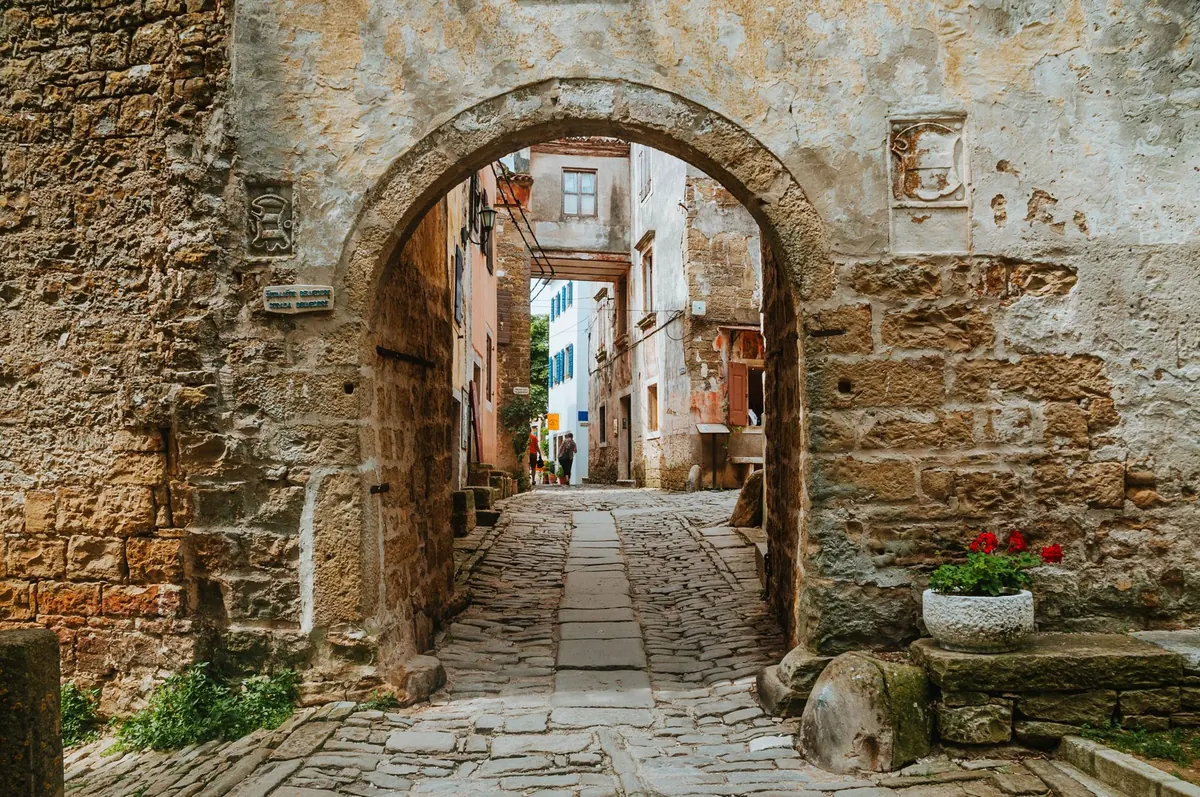
The precinct wall is the clearest planning decision an abbey made. It sealed off a rectangle of land, with a gatehouse as the main entrance, and streets inevitably converged on that gate. Where the abbey controlled the land, the town was laid out to suit it.
Water mattered just as much. Monks needed clean supply and reliable drainage, so they cut leats, built conduits and dug mill races. Those same channels often served the town, powering mills and flushing waste away. The mill was usually the abbey's, and tenants were commonly obliged to grind their grain there and pay for the privilege — a condition known as suit of mill, and a reliable source of resentment as well as revenue.
Wool, land and the link to the countryside
Abbeys were among the largest landowners in the country, and their estates tied town and village together. Cistercian houses in particular ran sheep on a big scale, managing outlying farms and granges, selling fleeces and cloth through merchants in towns such as Boston, Hull and London. When a wool merchant in a market town did business, the seller was often a monastery. When a farmer brought grain to market, the toll he paid may have gone to the abbey, and the sermon he heard on Sunday may have been preached by a monk.
After the Dissolution
When the monasteries were closed in the 1530s and 1540s, the towns did not vanish — but they changed hands. Precinct buildings were sold, leased, and frequently quarried for stone. Market rights, fairs and manorial courts passed to lay landlords or to the borough. Several abbey churches survived because townspeople bought or claimed them as their parish church, which is why the parish church of St Albans, Tewkesbury or Selby is on a scale that seems wildly out of proportion to the town. Grammar schools and almshouses often replaced monastic ones, and the town took on the responsibilities the abbey had once shouldered.
How to read an abbey town on foot
You do not need a guidebook to see the evidence. Take an hour and work through this:
- Start at the gate. Find the remaining gatehouse or its site. Everything else in the town tends to radiate from it.
- Read the street names. Abbey Gate, Monk Street, Prior's Lane, Grange Road and Mill Lane are usually literal rather than decorative.
- Stand in the market square. Ask why it is where it is. It is almost always just outside the precinct, on the road that led to the gate.
- Follow the water. Look for a leat, a mill race or a culverted stream. If there is a mill, check who owned it — the answer is often the abbey.
- Measure the parish church. A church far grander than its town suggests a monastic origin or monastic money.
- Walk the precinct boundary. Look for straight lengths of wall, odd corners in later buildings, and streets that bend for no visible reason.
- Finish in the record office or local museum. The town's first charter, the abbey's cartulary and old maps will show you the plan that the buildings only hint at.
Once you know what to look for, the shape of the town stops being accidental. The market square, the wide street at the gate, the mill by the stream and the oversized church are all arguments the abbey won centuries ago, still visible in stone.
Related posts
More stories you’ll love reading